
Key Takeaways:
- Subcutaneous injection is the most common route for therapeutic peptides For example, the PT-141 Dosage Guide provides timing and frequency protocols that depend on correct subcutaneous technique. and is a skill most patients learn quickly with proper instruction
- Reconstitution technique matters — adding bacteriostatic water gently down the vial wall preserves peptide integrity
- Injection site rotation prevents lipodystrophy, irritation, and inconsistent absorption
- Sterility is not optional — contamination of injectable products is the single greatest practical risk in self-administered peptide therapy
- Storage, handling, and disposal all affect both safety and efficacy
At a Glance
| Property | Value |
|---|---|
| Skill Level | Beginner — most patients learn in 1-2 sessions |
| Needle Size | 29-31 gauge, 0.5 inch (insulin syringe) |
| Injection Angle | 45 degrees into pinched skin fold |
| Primary Sites | Abdomen, outer thigh, upper arm |
| Key Risk | Contamination from poor sterile technique |
How to Inject Peptides Subcutaneously
If you have been prescribed peptide therapy and told you will be self-injecting at home, you are probably feeling some mix of curiosity and apprehension. That is entirely normal. What I tell my patients is this: the injection itself is the easy part. Most people are surprised by how simple and painless it is once they have done it twice. The part that requires attention and discipline is everything around the injection — the reconstitution, the dosing math, the sterility, the storage.
This guide walks through every step. It is written for patients who have never injected anything before, but I have included enough technical detail that experienced self-administrators may find it useful as a reference.
One critical point before we begin: this guide assumes you are working with a prescribing physician. Self-administering peptides without medical oversight is something I strongly advise against. The injection technique itself is straightforward, but the decision of what to inject, how much, for how long, and how to monitor for problems — that requires clinical judgment.
What You Need: The Equipment List
Before your first injection, gather everything in one place. Working in a clean, well-lit area with all supplies at hand reduces errors and contamination risk.
Essential Supplies
Insulin syringes (29-31 gauge, 0.5 inch, 1mL or 0.5mL). These are the standard for subcutaneous peptide injection. The gauge refers to the needle diameter — higher numbers mean thinner needles. A 30-gauge needle is approximately 0.3mm in diameter. For context, that is thinner than most acupuncture needles. Do not reuse syringes. Ever. One injection, one syringe.
Bacteriostatic water (BAC water). This is sterile water containing 0.9% benzyl alcohol as a preservative. The preservative is important because it inhibits bacterial growth in the multi-use vial after you puncture the rubber stopper. Do not substitute normal saline, sterile water for injection (which has no preservative), or anything else unless specifically instructed by your physician.
Alcohol swabs (70% isopropyl alcohol). Used to clean the vial stopper and the injection site. These are inexpensive and available at any pharmacy. Buy them pre-packaged individually rather than using a bottle and cotton balls — the pre-packaged swabs are more reliably sterile.
Sharps container. A puncture-resistant container for used needles and syringes. Most pharmacies sell these inexpensively, or you can use a thick plastic laundry detergent bottle with a screw cap in a pinch. Never throw loose needles in regular trash.
Clean surface and good lighting. A kitchen counter or desk wiped down with disinfectant. You need enough light to read the syringe markings clearly.
Optional but Helpful
Mixing syringe with a larger needle (18-21 gauge). Some practitioners prefer to use a larger-bore needle for reconstitution (drawing bacteriostatic water and injecting it into the peptide vial), then switch to the fine insulin needle for the actual injection. This is a reasonable approach — the larger needle makes drawing thicker liquids easier and reduces the number of times you puncture the peptide vial stopper with the fine needle. But it is not strictly necessary; many patients reconstitute and inject with the same insulin syringe without issues.
Timer or clock. Useful during reconstitution to avoid rushing the dissolution step.
Step 1: Reconstitution — Turning Powder into Solution
Most therapeutic peptides arrive as a lyophilized (freeze-dried) powder in a small glass vial sealed with a rubber stopper and aluminum crimp cap. This powder must be reconstituted — dissolved in bacteriostatic water — before it can be injected. The reconstitution step is where the most common mistakes happen, so take your time.
Calculate Your Water Volume
Your physician or pharmacist should tell you exactly how much bacteriostatic water to add. If they have not, ask. The amount of water determines the concentration of the solution, which in turn determines how much liquid you draw for each dose.
A common reconstitution example: if you have a 5mg vial of BPC-157 peptide therapy and add 2mL of bacteriostatic water, your concentration is 2.5mg per mL, which means 250mcg per 0.1mL (10 units on an insulin syringe). Write this number down and keep it with your supplies. Note that not all peptides require injection — BPC-157 in particular can be taken orally for GI-specific goals; see our BPC-157 oral vs injection comparison to understand when each route is appropriate.
The Reconstitution Process
-
Wash your hands thoroughly with soap and water for at least 20 seconds. Dry with a clean towel or paper towel.
-
Clean the vial stoppers. Take an alcohol swab and firmly wipe the rubber stopper of both the peptide vial and the bacteriostatic water vial. Let the alcohol dry completely — about 10 to 15 seconds. Do not blow on it.
-
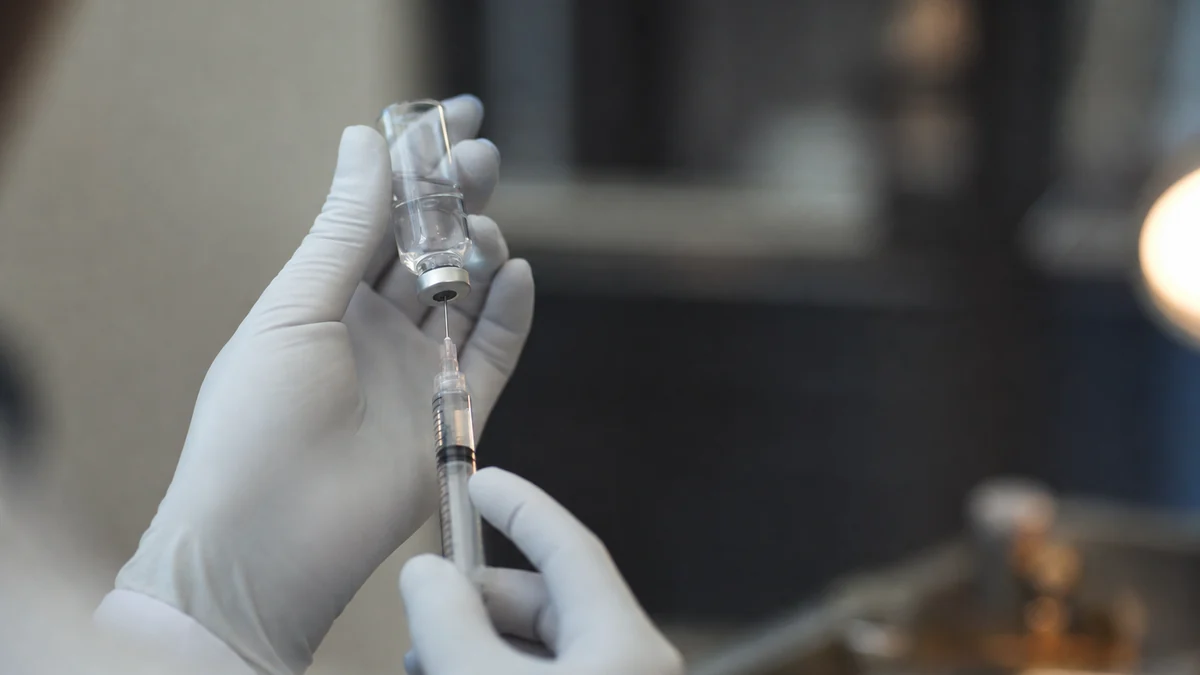
Draw the bacteriostatic water. Remove the cap from your syringe, pull the plunger back to draw in air equal to the volume of water you need (this creates positive pressure in the water vial, making it easier to draw fluid). Insert the needle through the center of the BAC water vial stopper, push in the air, invert the vial, and slowly draw the correct amount of water.
-
Add water to the peptide vial — gently. This is the step people rush, and it matters. Insert the needle into the peptide vial and aim the needle tip at the glass wall of the vial, not directly at the powder cake. Depress the plunger slowly, letting the water trickle down the inside wall of the vial. Do not squirt the water directly onto the powder. Aggressive force can damage peptide bonds and reduce potency.
-
Let it dissolve. Set the vial down on a flat surface and let the water work. Most peptides dissolve within two to five minutes. You can gently tilt the vial or roll it between your palms if needed. Do not shake the vial. Shaking creates foam and can damage the peptide through mechanical stress. If the solution is not clear after five minutes of gentle swirling, wait longer. If it remains cloudy or has visible particles after 15 minutes, do not use it — contact your prescriber.
-
Inspect the solution. A properly reconstituted peptide should be clear and colorless (some peptides have a very slight yellow tint, which is normal). Any cloudiness, particles, or unusual color is a reason to discard the vial.

Step 2: Drawing Your Dose
With your peptide reconstituted, drawing each dose follows a consistent process.
-
Clean the vial stopper with a fresh alcohol swab. Every single time you access the vial.
-
Draw in air equal to your dose volume. This makes drawing easier and maintains vial pressure.
-
Insert, inject air, invert, draw. Push the air into the vial, invert the vial with the syringe still inserted, and slowly pull the plunger to your target volume. Watch the liquid level, not the plunger — the plunger can be misleading if there is an air bubble.
-
Remove air bubbles. With the syringe still in the inverted vial, tap the syringe barrel firmly with your fingernail to float any bubbles to the top (near the needle). Push the plunger slightly to expel the air bubble back into the vial, then redraw to your correct volume. A tiny bubble is not dangerous in a subcutaneous injection — it will be absorbed harmlessly — but it affects dose accuracy.
-
Withdraw the needle from the vial. Do not set the uncapped needle down on any surface. You are now ready to inject.
Reading an Insulin Syringe
Insulin syringes are marked in “units,” where 100 units equals 1mL. So:
- 10 units = 0.1mL
- 5 units = 0.05mL
- 1 unit = 0.01mL
If your concentration is 250mcg per 0.1mL and your dose is 250mcg, you draw to the 10-unit mark. If your dose is 500mcg at that concentration, you draw to the 20-unit mark. Double-check your math every time. A dosing error with peptides is rarely dangerous in a single instance, but consistently taking the wrong dose defeats the purpose of the therapy.
Step 3: The Injection
This is the part that causes the most anxiety and turns out to be the simplest step.
Choose Your Site
Abdomen — the preferred site for most patients. Use the area around the navel, approximately two inches out in any direction. Avoid the immediate area around the navel itself and any skin that is bruised, scarred, or has stretch marks.
Outer thigh — the area on the outer front of the thigh, roughly midway between the hip and knee. This site has more subcutaneous fat in most people and is easy to reach.
Upper outer arm — the back of the upper arm between the shoulder and elbow. This site can be awkward to reach for self-injection but is a useful rotation option.
Back of the hip / love handle area — another viable rotation site with good subcutaneous tissue.
The Injection Process
-
Clean the injection site with an alcohol swab using a circular motion from the center outward. Let it dry completely. Injecting through wet alcohol stings.
-
Pinch the skin. With your non-dominant hand, gently pinch a fold of skin between your thumb and index finger. This lifts the subcutaneous fat layer away from the muscle beneath. Hold this pinch throughout the injection.
-
Insert the needle. Hold the syringe like a pencil or a dart with your dominant hand. Insert the needle into the pinched skin fold at approximately a 45-degree angle. In a quick, smooth motion — not slow and tentative. The faster and more decisive the insertion, the less you feel it. The needle should go in its full length (0.5 inch).
-
Release the pinch (optional — some protocols say to maintain the pinch, others say to release. For subcutaneous injection with an insulin needle, either approach works. I generally advise maintaining the pinch).
-
Inject slowly. Depress the plunger steadily over two to three seconds. There is no need to rush. Injecting too fast can cause a momentary stinging sensation.
-
Withdraw the needle at the same angle you inserted it. Press the alcohol swab or a clean cotton ball gently over the site. Do not rub — rubbing can spread the medication laterally and increase bruising.
-
Dispose of the syringe immediately in your sharps container. Do not recap the needle.

What You Might Feel
Most patients report that the injection itself is barely noticeable — less painful than a blood draw or a mosquito bite. Some common experiences:
- A brief pinch or sting during needle insertion
- A slight burning sensation during injection (varies by peptide — some peptides sting more than others)
- A small raised bump at the injection site that resolves within 30 to 60 minutes (this is normal and just the fluid depot)
- Mild redness or itching at the site for a few hours
What is not normal and warrants contacting your physician: significant swelling, increasing redness that spreads beyond the immediate site, warmth or heat at the injection area, fever, or any systemic symptoms after injection.
Injection Site Rotation: Why It Matters
Using the same injection spot repeatedly causes problems. The two main risks are lipodystrophy — changes in the fat tissue at the injection site that can appear as lumps, dimples, or hardened areas — and inconsistent absorption, since scarred or fibrotic tissue absorbs differently.
A Simple Rotation System
Divide your abdomen into four quadrants (upper left, upper right, lower left, lower right). Rotate through them in order. Within each quadrant, vary the exact spot by at least one inch from the previous injection. Some patients find it helpful to keep a simple log — date, site, quadrant — on a notepad or phone app.
If you are injecting daily, a four-quadrant abdominal rotation gives each site a four-day rest. If you add thighs and upper arms, you have eight or more sites in the rotation, which provides even more recovery time.
In my clinical experience, patients who are disciplined about rotation have noticeably fewer injection site reactions and more consistent therapeutic results than those who default to the same comfortable spot every time.
Storage and Handling
Peptide stability after reconstitution is a real concern. These are proteins, and they degrade.
Before Reconstitution (Lyophilized Powder)
- Refrigerate at 2 to 8 degrees Celsius (36 to 46 degrees Fahrenheit). Most lyophilized peptides are stable for months under refrigeration.
- Some peptides can tolerate brief periods at room temperature during shipping, but get them refrigerated promptly upon arrival.
- Do not freeze lyophilized peptides unless the manufacturer specifically says it is acceptable.
- Keep away from direct light. The original box or a foil wrap is sufficient.
After Reconstitution
- Refrigerate immediately. Reconstituted peptides are more fragile than the lyophilized form.
- Use within the timeframe your prescriber specifies — typically 14 to 28 days for most peptides reconstituted with bacteriostatic water. Some peptides degrade faster than others.
- Never freeze reconstituted peptide solutions. Freezing and thawing disrupts the protein structure.
- Do not leave the vial out at room temperature for extended periods. Take it out, draw your dose, put it back.
- If the solution changes color, becomes cloudy, or develops particles, discard it.
Travel Considerations
If you travel with peptides, use a small insulated cooler bag with a cold pack. Do not put vials in checked luggage — temperature extremes in cargo holds can destroy them. Carry them in your carry-on with your prescription documentation.
TSA and most international security agencies allow injectable medications with appropriate documentation (a letter from your prescribing physician, the prescription label on the vial). I advise patients to carry a simple letter on clinic letterhead explaining the medication, the condition being treated, and the prescribing physician’s contact information.
Sterility: The Non-Negotiable
Let me be direct about this. In my clinical experience, the single greatest practical risk in self-administered peptide therapy is not the peptide itself, not the needle, not a dosing error. It is contamination from poor sterile technique.
Injectable peptides bypass your body’s first-line defenses — skin, stomach acid, mucous membranes. Anything on the needle, in the solution, or on the vial stopper goes directly into your tissue. Bacterial contamination can cause local infections (cellulitis, abscess) or, in rare cases, systemic infection.
The Rules
- Wash your hands before every injection session. Not just a quick rinse — soap, water, 20 seconds, under the nails.
- Swab every surface you will puncture with alcohol. Every time. The vial stopper, the injection site. Let alcohol dry before puncturing.
- Never touch the needle. If you accidentally touch it, if it contacts any non-sterile surface, discard the syringe and start with a new one. Needles are inexpensive. Infections are not.
- Never reuse syringes or needles. The needle dulls after a single use (microscopic barbing occurs), and the syringe barrel is no longer sterile.
- Work in a clean environment. Not the bathroom (high bacterial load). A clean kitchen counter or desk is preferable.
- Do not prepare injections for multiple days in advance. Draw your dose fresh each time.
- Store supplies properly. Keep syringes in their sealed packaging until use. Keep bacteriostatic water sealed and at room temperature or refrigerated.
Troubleshooting Common Issues
The powder will not dissolve. Be patient. Some peptides take longer. Gentle rolling or tilting is fine. Never shake. If it does not dissolve after 30 minutes, contact your prescriber — the peptide may be damaged.
I see bubbles in my syringe. Small bubbles are not dangerous in subcutaneous injection, but they affect dose accuracy. Tap the syringe to float them up and push them out before injecting.
I am getting bruises at injection sites. Minor bruising is common and not medically concerning. Make sure you are rotating sites. Avoid injecting near visible veins. Do not rub the site after injection. If you take blood thinners or anticoagulants, discuss injection technique with your physician — you may need to apply pressure longer.
The injection stings. Some peptides cause more local discomfort than others. Allowing the alcohol to dry completely before injecting reduces stinging. Some patients find that letting the reconstituted vial warm slightly (hold it in your hand for a minute — do not microwave or heat it) reduces discomfort.
I pulled back the plunger and saw blood. This means you may have hit a small blood vessel. For subcutaneous injection, this is not dangerous. Remove the needle, apply pressure, and inject in a different spot with a new syringe. This is uncommon with proper subcutaneous technique.
I forgot whether I injected today. If you are unsure, skip the dose. Missing one dose of a peptide is virtually always inconsequential. Doubling a dose carries more risk than missing one.
What I Tell My Patients
The technical skill of subcutaneous injection is something our clinical team has taught to thousands of patients over the years — from anxious teenagers to elderly patients with arthritis — and the vast majority master it quickly. The needle anxiety is almost always worse than the reality.
What I emphasize more than technique is discipline around sterility and consistency. The patients who do best with peptide therapy are the ones who treat their injection preparation like a ritual — same clean surface, same sequence of steps, same careful attention to the alcohol swab and the reconstitution technique. It becomes automatic within a week.
Here is what the evidence shows regarding self-injection outcomes: multiple studies on self-administered subcutaneous medications (insulin, growth hormone, interferon, anticoagulants) demonstrate that properly trained patients achieve injection technique comparable to healthcare professionals, with very low rates of complications when hygiene and site rotation protocols are followed.
In our clinical experience at St. George Hospital, we dedicate a full training session to injection technique before any patient begins a self-administered peptide protocol. We observe their first injection, correct technique in real time, and provide written materials they take home. This investment of 30 minutes upfront prevents the vast majority of problems we would otherwise see downstream.
The Bottom Line
Subcutaneous peptide injection is a practical, learnable skill. The needle is small, the technique is simple, and most patients are surprised by how little discomfort is involved. The critical factors are not dexterity or courage — they are sterility, proper reconstitution, accurate dosing, and site rotation. Treat each injection with the same care and attention, regardless of whether it is your first or your hundredth. And always — always — work with a prescribing physician who can guide your protocol, monitor your response, and adjust your course.
References
- Frid AH, et al. New insulin delivery recommendations. Mayo Clinic Proceedings. 2016;91(9):1231-1255. doi:10.1016/j.mayocp.2016.06.010
- Birkebaek NH, et al. Injection site reactions and attitudes to injection in patients on injectable medications. Current Medical Research and Opinion. 2019;35(7):1215-1222.
- Patton JS, et al. Subcutaneous injection technique: a systematic review. British Journal of Clinical Pharmacology. 2015;80(4):654-672.
- Spollett GR. Insulin injection technique: Key to achieving optimal glycemic control. Diabetes Spectrum. 2020;33(1):14-20.
- USP Chapter 797: Pharmaceutical Compounding — Sterile Preparations. United States Pharmacopeia. Revised 2023.
- Ginsberg BH. Factors affecting blood glucose self-monitoring. Diabetes Care. 2009;32(Suppl 2):S169-S173.