Two of the most discussed anti-aging interventions in longevity medicine target two entirely different hallmarks of aging. Epithalon targets telomere attrition. NMN targets NAD+ decline. Comparing them head-to-head is like comparing insulin to a statin — both address metabolic health, but through mechanisms so different that the comparison almost misses the point.
And yet, the comparison matters, because patients have limited budgets and limited willingness to take multiple interventions, and they want to know: if I can only do one, which one?
Here is what the evidence shows.
At a Glance
| Property | Epithalon | NMN |
|---|---|---|
| Classification | Synthetic tetrapeptide | NAD+ precursor (vitamin B3 derivative) |
| Primary Target | Telomere attrition (Hallmark #5) | NAD+ decline / Deregulated nutrient sensing (Hallmarks #7, #8) |
| Mechanism | Telomerase activation (TERT gene expression) | NAD+ biosynthesis via salvage pathway |
| Animal Lifespan Data | Consistent 15-25% extension (rats, mice, Drosophila) | Mixed; NMN improves healthspan markers but lifespan data inconsistent |
| Human Trial Data | Cell line studies; case reports only | Multiple RCTs (2021-2025) |
| Administration | Subcutaneous injection, 10-20 day courses | Oral capsule, daily |
| Typical Dose | 5-10 mg SC daily (courses) | 250-1000 mg oral daily (continuous) |
| Cost | Moderate-high (intermittent courses) | Moderate (continuous daily) |
| Regulatory Status | Not approved | Dietary supplement (US); varies internationally |
Two Hallmarks, Two Mechanisms
The Lopez-Otin hallmarks of aging framework identifies twelve interconnected biological processes that drive aging. Epithalon and NMN address different entries on this list.
Epithalon: Telomere Attrition
Every time a cell divides, its telomeres — the protective DNA caps at chromosome ends — shorten slightly because DNA polymerase cannot fully replicate the terminal sequence. When telomeres reach a critical length, the cell enters senescence (permanent growth arrest) or apoptosis (programmed death). Over a lifetime, accumulated senescent cells drive inflammation, tissue dysfunction, and age-related disease.
Telomerase is the enzyme that rebuilds telomeres. It is active in stem cells and germ cells but silenced in most somatic cells after development. Epithalon reactivates the TERT gene, producing telomerase enzyme that can reverse or slow telomere shortening.
The logic: if you can maintain telomere length, you delay replicative senescence and preserve tissue regeneration capacity.
NMN: NAD+ Decline
NAD+ (nicotinamide adenine dinucleotide) is a coenzyme present in every cell, essential for hundreds of metabolic reactions. NAD+ levels decline approximately 50% between ages 40 and 60, and this decline is now considered a fundamental driver of multiple aging processes:
- Energy metabolism. NAD+ is required for mitochondrial electron transport chain function.
- DNA repair. PARP enzymes (which repair DNA damage) consume NAD+ as a substrate. Low NAD+ means impaired DNA repair.
- Sirtuin activation. Sirtuins (SIRT1-7) are NAD+-dependent deacetylases that regulate metabolism, inflammation, and stress resistance.
- Immune function. CD38, an NAD+-consuming enzyme, increases with age and drives further NAD+ depletion.
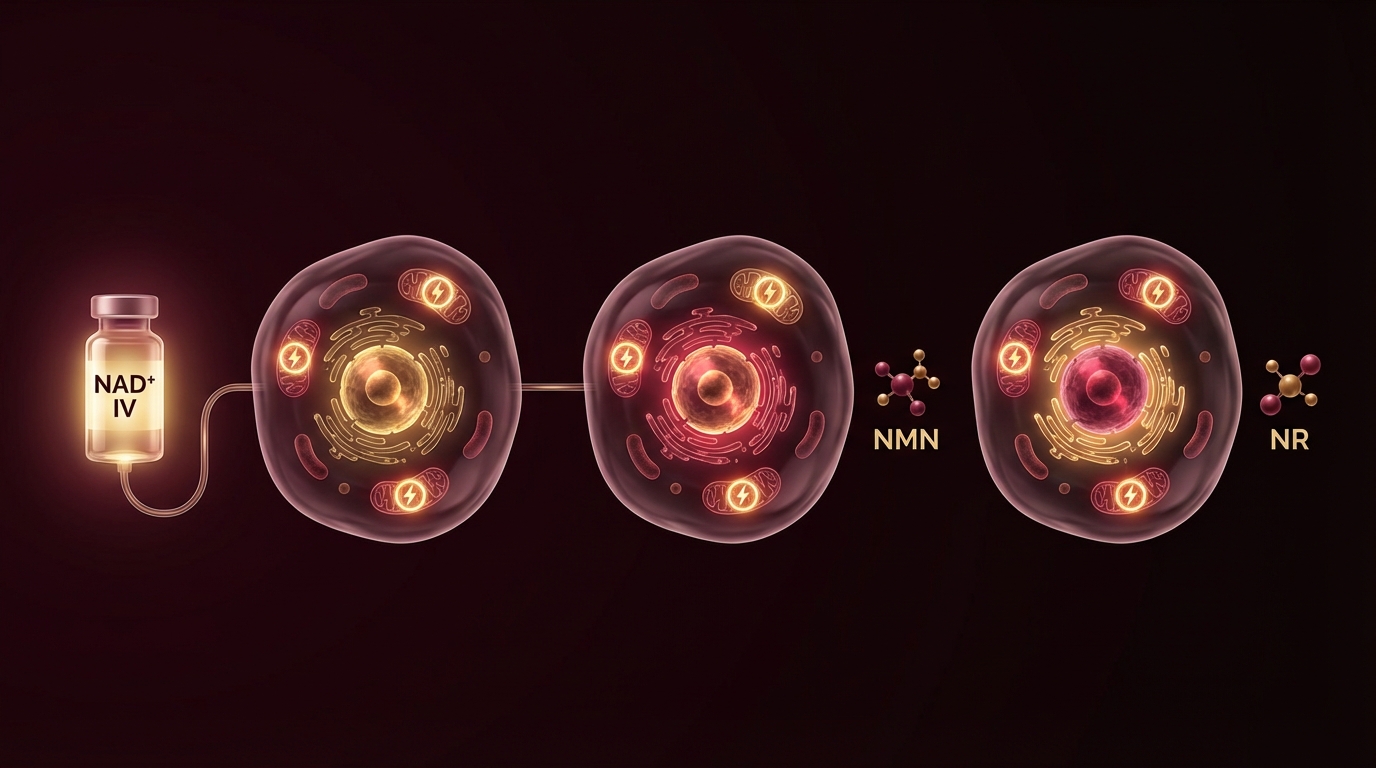
NMN (nicotinamide mononucleotide) is a direct precursor to NAD+, entering the salvage pathway one step before NAD+ synthesis. Oral NMN supplementation reliably increases tissue NAD+ levels in both animals and humans.
The Evidence: Honest Comparison
Epithalon Evidence
Strongest point: Animal lifespan extension.
This is Epithalon’s defining evidence. Multiple studies by Anisimov, Khavinson, and colleagues demonstrate consistent lifespan extension:
- Female SHR mice: approximately 25% increase in mean lifespan, with reduced spontaneous tumor incidence (Anisimov et al., 2003)
- Drosophila: 10-16% median lifespan extension
- The lifespan extension is seen with intermittent 10-day courses, not continuous administration
Mechanistic confirmation in human cells:
- Telomerase activation and telomere elongation demonstrated in human fetal lung fibroblasts, with treated cells exceeding the Hayflick limit (Khavinson et al., 2003)
- The 2025 Springer confirmation validated the telomere-lengthening mechanism in human cell lines
Weakest point: No human longevity trials. There are no randomized controlled trials measuring clinical outcomes or biomarkers of aging in human subjects receiving Epithalon. The case report showing 7.9-year biological age reduction used a multi-intervention protocol, making Epithalon’s specific contribution impossible to isolate.
NMN Evidence
Strongest point: Human pharmacokinetic and metabolic data.
NMN has more recent human trial data than Epithalon:
- Yi et al. (2023): RCT showing NMN (250 mg/day) increased blood NAD+ levels by approximately 40% and improved walking speed and grip strength in middle-aged and older adults
- Igarashi et al. (2022): 12-week RCT demonstrating NMN (250 mg/day) improved aerobic capacity in recreational runners
- Multiple pharmacokinetic studies confirming oral NMN bioavailability and tissue NAD+ elevation
Moderate point: Animal healthspan data.
NMN consistently improves metabolic markers, endurance, insulin sensitivity, and vascular function in aged mice (Mills et al., 2016). These are healthspan benefits — the animals function better — but the lifespan data is less consistent than Epithalon’s.
Weakest point: Lifespan extension is not clearly established. While NMN improves multiple biomarkers of aging in animals, direct lifespan extension has not been as consistently demonstrated as with Epithalon. The Interventions Testing Program (ITP), which uses rigorous multi-site protocols, has not confirmed NMN lifespan extension in mice at the doses tested.
The Evidence Gap
| Criterion | Epithalon | NMN |
|---|---|---|
| Animal lifespan extension | Consistent (multiple studies) | Inconsistent |
| Human clinical trials | None (cell line + case report) | Multiple RCTs |
| Human biomarker improvement | Case reports only | NAD+ levels, physical performance |
| Mechanistic clarity | Clear (telomerase → telomere) | Clear (NMN → NAD+ → multiple pathways) |
| Long-term human safety | Minimal data | Growing (2+ years in some cohorts) |
| FDA/EMA pathway | None | Supplement (US); FDA contested status for dietary supplement claims |
This creates an interesting paradox: Epithalon has better animal lifespan data but worse human data. NMN has better human data but weaker lifespan evidence. Each is strong where the other is weak.
Practical Comparison: Choosing Your Protocol
Choose Epithalon When:
- Telomere length is your primary concern. Patients with documented short telomeres for age may prioritize direct telomere support.
- You have physician supervision. Epithalon requires subcutaneous injection and monitoring.
- You prefer intermittent protocols. 10-20 days of treatment, 1-2 times per year, rather than daily supplementation.
- Lifespan extension data is your priority. Epithalon’s animal data is the strongest in this category.
Choose NMN When:
- NAD+ decline is your primary concern. Patients with fatigue, declining exercise capacity, or metabolic dysfunction may benefit from NAD+ replenishment.
- You prefer oral supplementation. NMN capsules are simpler than injections.
- You want human trial support. NMN has RCT data for biomarker improvement.
- You are already experiencing age-related metabolic changes. NMN addresses the energy metabolism and DNA repair pathways most relevant to metabolic aging.
Consider Both When:
- You are pursuing comprehensive longevity optimization. The mechanisms are entirely non-overlapping, making this one of the most rational peptide-supplement combinations.
- Budget allows. Epithalon’s intermittent dosing (a few hundred dollars, twice yearly) combined with NMN’s daily cost (moderate) is feasible for most patients pursuing longevity medicine.
- You are tracking biomarkers. When using both, you can independently track telomere length (Epithalon’s target) and NAD+ levels or metabolic markers (NMN’s target).
What I See in Practice
In my clinical experience, the majority of patients pursuing longevity optimization use NMN daily and add Epithalon as an intermittent course — and this is the approach I generally recommend.
The rationale is pragmatic:
-
NMN addresses the most immediately impactful aging pathway. NAD+ decline affects cellular energy, DNA repair, and inflammation simultaneously. Replenishing NAD+ produces the most rapid and perceptible improvements in energy, exercise capacity, and metabolic function.
-
Epithalon addresses the longer-term structural aging pathway. Telomere shortening is a slower process, and its consequences (replicative senescence, tissue aging) manifest over years to decades. Epithalon is a strategic, long-horizon intervention.
-
NMN effects are more immediately measurable. Patients can track NAD+ levels, mitochondrial function markers, and subjective energy within weeks. Epithalon’s effects on telomere length take months to assess and are noisier to measure.
What I tell my patients: if I could only choose one intervention for someone in their 40s-50s experiencing the initial symptoms of aging (declining energy, slower recovery, metabolic changes), I would start with NMN because the effects are more immediate and the evidence base is more accessible. I would add Epithalon after establishing the NMN baseline, as a strategic addition to the protocol targeting a different dimension of aging.
For patients over 60 with documented short telomeres, I prioritize Epithalon more aggressively because telomere attrition becomes a more urgent concern with advancing age.
Mechanism Deep Dive: Why They Are Complementary
The twelve hallmarks of aging are interconnected, and Epithalon and NMN intersect at several points:
Telomere attrition and NAD+ decline feed each other. Short telomeres activate the DNA damage response, which consumes NAD+ (via PARP activation). Low NAD+ impairs sirtuin function, which reduces the expression of TERT and other telomere-protective genes. This creates a vicious cycle that accelerating aging.
By addressing both telomere attrition (Epithalon) and NAD+ decline (NMN), you potentially interrupt this cycle at two points simultaneously. This is the theoretical rationale for combination therapy, though it has not been directly tested in any study.
Shared downstream pathway — sirtuins. Both Epithalon and NMN influence sirtuin activity, though through different upstream mechanisms. NMN provides the NAD+ substrate that sirtuins require. Epithalon may indirectly support sirtuin expression through telomere-mediated reduction in DNA damage signaling. The result is converging support for sirtuin-mediated epigenetic regulation, stress resistance, and metabolic health.
Safety Comparison
| Concern | Epithalon | NMN |
|---|---|---|
| Route | Injection | Oral |
| Long-term human data | Minimal | Growing |
| Cancer concern | Theoretical (telomerase); animal data shows tumor reduction | No significant concern |
| GI side effects | None (injected) | Mild in some individuals |
| Drug interactions | Unknown | Minimal |
| Pregnancy safety | No data | No data |
Both are generally well-tolerated. The primary safety difference is that Epithalon’s telomerase mechanism raises a theoretical cancer concern (addressed by animal data showing reduced, not increased, tumor incidence) while NMN has no known mechanism for cancer promotion.
The Bottom Line
Epithalon and NMN are not competitors — they are complementary interventions targeting different hallmarks of aging. Epithalon has stronger animal lifespan data but weaker human clinical data. NMN has stronger human trial data but weaker lifespan evidence. The rational approach for patients pursuing comprehensive longevity optimization is to use both, tracked with appropriate biomarkers. For patients who must choose one, the decision depends on their primary concern: telomere attrition (Epithalon) or metabolic aging and NAD+ decline (NMN). In my clinical practice, NMN tends to be the foundation and Epithalon the strategic addition, but both deserve a place in evidence-informed longevity medicine.
Back to Epithalon Overview | All Peptide Articles
References
- Khavinson VKh, Bondarev IE, Butyugov AA. “Epithalon peptide induces telomerase activity and telomere elongation in human somatic cells.” Bull Exp Biol Med. 2003;135(6):590-592. DOI: 10.1023/A:1025493705728.
- Anisimov VN, Khavinson VKh, Popovich IG, et al. “Effect of Epitalon on biomarkers of aging, life span and spontaneous tumor incidence in female Swiss-derived SHR mice.” Biogerontology. 2003;4(4):193-202.
- Yi L, Maier AB, Tao R, et al. “The efficacy and safety of beta-nicotinamide mononucleotide (NMN) supplementation in healthy middle-aged adults: a randomized, multicenter, double-blind, placebo-controlled, parallel-group, dose-dependent clinical trial.” Geroscience. 2023;45(1):29-43. DOI: 10.1007/s11357-022-00705-1.
- Mills KF, Yoshida S, Stein LR, et al. “Long-term administration of nicotinamide mononucleotide mitigates age-associated physiological decline in mice.” Cell Metab. 2016;24(6):795-806. DOI: 10.1016/j.cmet.2016.09.013.
- Lopez-Otin C, Blasco MA, Partridge L, et al. “Hallmarks of aging: an expanding universe.” Cell. 2023;186(2):243-278. DOI: 10.1016/j.cell.2022.11.001.
Disclaimer: This article is provided for educational purposes and reflects one physician’s clinical approach. Epithalon is not approved by the FDA or EMA. NMN regulatory status varies by jurisdiction. This is not a substitute for individualized medical care. Consult a qualified physician before beginning any longevity protocol.