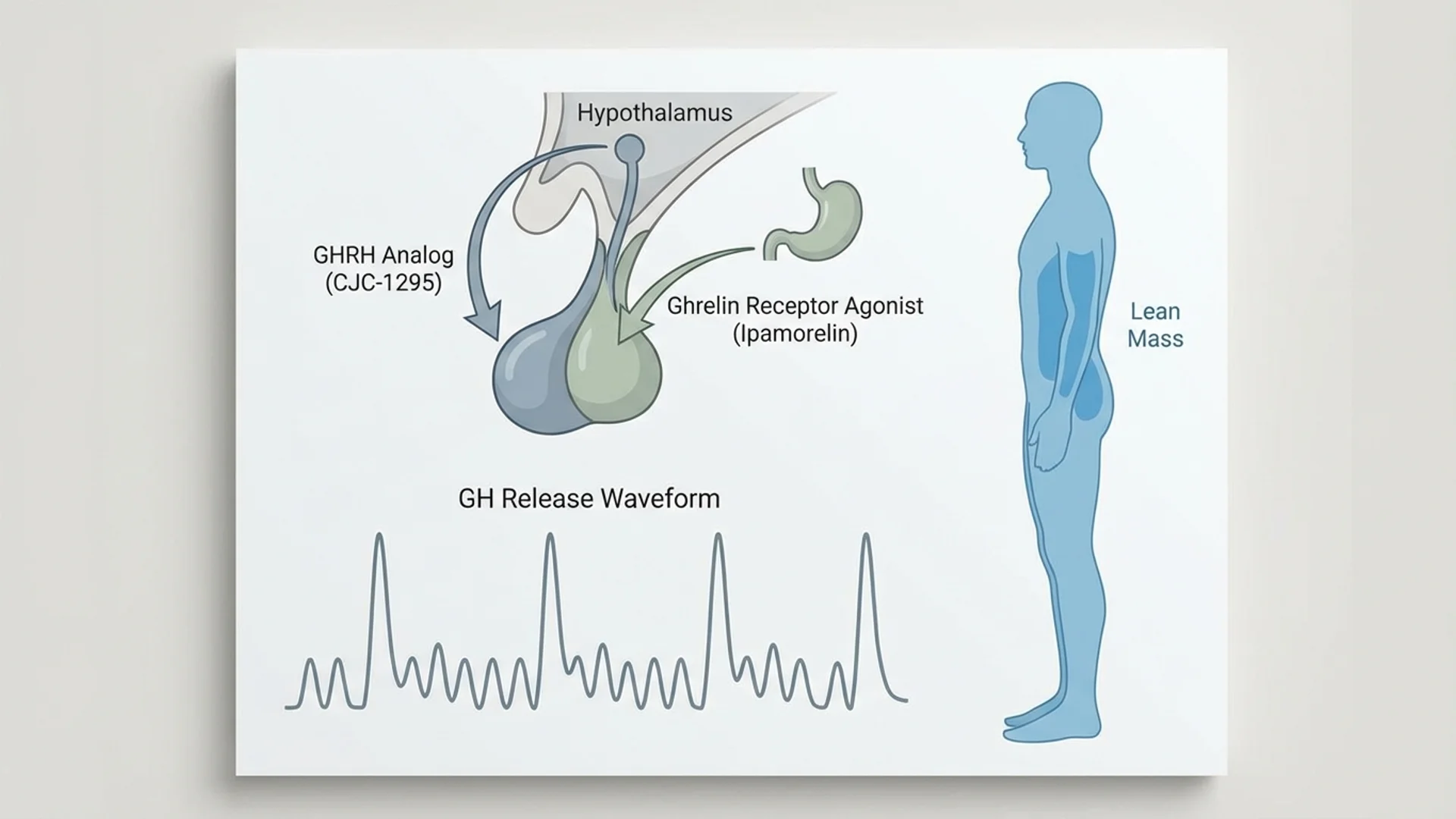
Growth hormone secretagogues are the most commonly prescribed peptide category in my clinical practice, and the CJC-1295/Ipamorelin combination is the workhorse protocol. The appeal is straightforward: rather than injecting exogenous growth hormone (which suppresses endogenous production and carries significant regulatory and safety considerations), you stimulate your own pituitary gland to release growth hormone in a pattern that approximates physiological secretion.
The dosing, however, requires understanding a critical distinction that most online resources get wrong. Let me clarify. Patients who prefer a sermorelin-based protocol with similar pulsatility characteristics will find a parallel titration guide in Sermorelin Dosage & Protocol Guide.
At a Glance
| Property | Value |
|---|---|
| Evidence Level | Moderate (individual components studied in humans; combination protocol from clinical practice) |
| Standard Dose | CJC-1295: 100-300 mcg + Ipamorelin: 100-300 mcg |
| Timing | Evening, 30-60 minutes before sleep |
| Frequency | 5-6 nights per week |
| Cycle Length | 8-16 weeks on, 4-8 weeks off |
| Route | Subcutaneous injection |
| Key Mechanism | Dual GHRH + ghrelin receptor stimulation for synergistic GH release |
The Critical Distinction: DAC vs No-DAC
Before discussing doses, I need to address the single most common source of confusion in CJC-1295 dosing.
CJC-1295 exists in two forms:
CJC-1295 with DAC (Drug Affinity Complex)
- Contains a maleimido modification that binds to serum albumin
- Half-life: approximately 8 days
- Produces sustained, non-pulsatile GH elevation
- Typically dosed 1-2 times per week at 1-2 mg
- NOT the version typically combined with Ipamorelin
CJC-1295 without DAC (Modified GRF 1-29 / Mod GRF)
- The first 29 amino acids of GHRH, modified for protease resistance
- Half-life: approximately 30 minutes
- Produces a natural GH pulse when combined with Ipamorelin
- Typically dosed nightly at 100-300 mcg
- This is the version used in the standard combination protocol
This distinction matters enormously. CJC-1295 with DAC produces continuous GH elevation, which does not mimic normal physiology and carries different risk profiles. CJC-1295 without DAC (Mod GRF 1-29) produces pulsatile GH release, which is what we want. When I refer to CJC-1295 throughout this article, I mean the no-DAC version unless otherwise specified.
Why the Combination Works: Dual Mechanism
The rationale for combining CJC-1295 and Ipamorelin is pharmacological synergy through two complementary pathways:
CJC-1295 (Mod GRF 1-29): The GHRH Signal
CJC-1295 binds to GHRH receptors on somatotroph cells in the anterior pituitary, stimulating growth hormone synthesis and release. This mimics the natural GHRH pulse that occurs during deep sleep. Sermorelin — the original 29-amino-acid GHRH analogue — operates via the same receptor and offers a comparable pulsatile mechanism with an extensive clinical track record; patients newer to GH peptide therapy may find our sermorelin physician guide a useful primer before moving to modified analogues.
Ipamorelin: The Ghrelin Signal
Ipamorelin is a selective growth hormone secretagogue receptor (GHS-R / ghrelin receptor) agonist. It amplifies the GH response to GHRH signaling. Importantly, Ipamorelin is the most selective ghrelin receptor agonist available — unlike GHRP-2 and GHRP-6, Ipamorelin does not significantly elevate cortisol, ACTH, or prolactin (Raun et al., 1998).
Synergy
When both receptors are activated simultaneously, the resulting GH pulse is significantly larger than either signal alone. This is not additive — it is synergistic. The GHRH pathway sets the amplitude of the GH pulse, while the ghrelin pathway potentiates the pituitary’s sensitivity to that signal.
The nightly dosing strategy exploits the fact that the largest physiological GH pulse occurs during the first cycle of slow-wave sleep. By administering both peptides before bed, you amplify the most important GH secretory event of the day.
Dosing Protocol: What the Evidence and Practice Support
Standard Nightly Protocol
| Parameter | CJC-1295 (Mod GRF 1-29) | Ipamorelin |
|---|---|---|
| Dose per injection | 100 mcg (conservative) to 300 mcg (standard) | 100 mcg (conservative) to 300 mcg (standard) |
| Timing | 30-60 minutes before sleep | Same injection (can be mixed) |
| Frequency | 5-6 nights per week (1-2 off-nights per week) | Same |
| Cycle length | 8-16 weeks | Same |
| Off-cycle | 4-8 weeks | Same |
Dosing Tiers
| Tier | CJC-1295 | Ipamorelin | Best For |
|---|---|---|---|
| Conservative | 100 mcg | 100 mcg | First-time users, older patients, GH sensitivity assessment |
| Standard | 200 mcg | 200 mcg | Most patients, long-term optimization |
| Maximum | 300 mcg | 300 mcg | Patients with documented low IGF-1 or poor initial response |
Why Not Higher?
Doses above 300 mcg of each peptide do not appear to produce proportionally greater GH release. The pituitary has a finite number of somatotroph cells and a physiological ceiling for GH secretion per pulse. Exceeding this ceiling does not produce more GH — it produces longer GH elevation, which is not the goal. We want a large, brief pulse followed by return to baseline, mimicking natural physiology.
The Evidence
What We Know (Human Data)
CJC-1295 individual data:
- Teichman et al. (2006) conducted a dose-escalation study of CJC-1295 (with DAC) in healthy adults. GH levels increased 2-10 fold depending on dose, with IGF-1 increasing 1.5-3 fold. The study confirmed the concept of GHRH analog-stimulated GH release in humans.
Ipamorelin individual data:
- Raun et al. (1998) demonstrated that Ipamorelin specifically releases GH without significantly affecting cortisol, ACTH, or prolactin levels. This selectivity is unique among growth hormone secretagogues and is the primary reason Ipamorelin is preferred over GHRP-2 and GHRP-6.
- Gobburu et al. (1999) characterized Ipamorelin’s pharmacokinetics and confirmed dose-dependent GH release with a favorable safety profile.
Combination data: No published clinical trials have evaluated the specific CJC-1295 (Mod GRF 1-29) + Ipamorelin combination. The combination protocol is derived from pharmacological rationale (dual receptor synergy) and clinical practice. This is an important transparency point — the combination is standard of care in peptide therapy clinics worldwide, but the specific protocol has not been validated by an RCT.
What I See in Practice
The CJC-1295/Ipamorelin combination is the peptide protocol I have prescribed most frequently, and my clinical observations are consistent:
IGF-1 response. The majority of patients show a meaningful increase in IGF-1 levels (typically 50-150 ng/mL increase from baseline) within 4-8 weeks. Response varies by age, baseline GH status, and individual pituitary function.
Body composition. Patients consistently report gradual fat loss (particularly visceral and truncal fat) and improved lean mass retention over 3-6 month cycles. This aligns with known GH physiology — GH promotes lipolysis and protein synthesis. See the CJC-1295/Ipamorelin weight loss article for detailed analysis.
Sleep quality. A frequently reported benefit. Patients describe deeper sleep, particularly in the first half of the night, consistent with enhanced slow-wave sleep associated with the amplified GH pulse.
Recovery. Athletes and active patients report improved recovery from training, reduced muscle soreness, and enhanced tissue repair. This is consistent with GH’s role in tissue regeneration.
Onset timeline. Most patients notice subjective improvements (sleep quality, recovery) within 2-4 weeks. Body composition changes become measurable at 6-8 weeks. Maximum benefit typically develops over 3-6 months.
Practical Administration
Injection Technique
- Both peptides can be drawn into the same syringe and injected simultaneously
- Inject subcutaneously into abdominal tissue, rotating injection sites
- Use insulin syringes (29-31 gauge) for minimal discomfort
- Inject at a 45-90 degree angle depending on subcutaneous tissue thickness
Timing Optimization
The timing of injection relative to sleep and meals matters:
30-60 minutes before sleep. This allows the peptides to stimulate a GH pulse that coincides with the first slow-wave sleep cycle.
At least 2 hours after the last meal. Insulin blunts GH secretion. A post-meal insulin spike will attenuate the GH response to the peptides. Ideally, the last meal is at least 2-3 hours before injection.
No carbohydrates or sugar after injection. For the same insulin reason, avoid food (especially carbohydrates) between injection and sleep.
Reconstitution and Storage
- Reconstitute lyophilized peptides with bacteriostatic water
- Store reconstituted vials refrigerated (2-8 degrees C)
- Use within 21-28 days of reconstitution
- Do not freeze reconstituted peptides
- Protect from light
The Off-Night Rationale
Taking 1-2 nights off per week serves two purposes:
- Pituitary sensitivity maintenance. Continuous stimulation of any receptor system can lead to desensitization. Intermittent rest periods may preserve pituitary responsiveness.
- IGF-1 feedback assessment. Off-nights allow the pituitary to demonstrate its unstimulated function, which can be clinically useful for monitoring.
Monitoring
Required Baseline Labs
- IGF-1 (the primary monitoring marker)
- Fasting glucose and insulin (GH affects glucose metabolism)
- HbA1c (baseline metabolic assessment)
- Complete metabolic panel
- Baseline body composition assessment (DEXA scan preferred)
Follow-Up Monitoring
| Timepoint | Tests |
|---|---|
| 4-6 weeks | IGF-1 (to confirm response and guide dose adjustment) |
| 8-12 weeks | IGF-1, fasting glucose, insulin |
| 6 months | Comprehensive panel including IGF-1, metabolic markers, DEXA |
IGF-1 Targets
The goal is to elevate IGF-1 into the upper physiological range for the patient’s age — not to supraphysiological levels. Target ranges vary by age, but generally:
- Age 30-40: IGF-1 target 200-280 ng/mL
- Age 40-50: IGF-1 target 180-250 ng/mL
- Age 50-60: IGF-1 target 150-220 ng/mL
- Age 60+: IGF-1 target 130-200 ng/mL
IGF-1 levels consistently above 300 ng/mL warrant dose reduction. Chronically elevated IGF-1 is associated with increased cancer risk in epidemiological studies.
Safety and Considerations
Common side effects:
- Water retention (mild, typically in the first 2-4 weeks, self-resolving)
- Increased hunger (Ipamorelin’s ghrelin receptor activation)
- Tingling or numbness in extremities (carpal tunnel-like symptoms from fluid shifts)
- Injection site reactions (mild)
Contraindications:
- Active malignancy (GH promotes cell proliferation)
- Uncontrolled diabetes (GH is counter-regulatory to insulin)
- Active diabetic retinopathy (GH can worsen retinal neovascularization)
- Pituitary tumors or active pituitary disease
- Pregnancy and lactation
- History of intracranial hypertension
Monitoring red flags:
- Fasting glucose increasing above normal range
- Persistent edema or significant water retention
- New joint pain or carpal tunnel symptoms that do not resolve
- IGF-1 levels above 300 ng/mL
The Bottom Line
CJC-1295 (Mod GRF 1-29) and Ipamorelin at 100-300 mcg each, injected subcutaneously before bed 5-6 nights per week for 8-16 week cycles, is the standard growth hormone secretagogue protocol. The combination exploits dual GHRH and ghrelin receptor stimulation for synergistic, pulsatile GH release that mimics natural physiology. Individual component data from human studies supports the mechanism, though the specific combination has not been tested in an RCT. In my clinical experience, this is one of the most reliably effective peptide protocols available, with a predictable response pattern and a manageable side effect profile when properly monitored.
Back to CJC-1295/Ipamorelin Overview | All Peptide Articles
References
- Teichman SL, Neale A, Lawrence B, et al. “Prolonged stimulation of growth hormone (GH) and insulin-like growth factor I secretion by CJC-1295, a long-acting analog of GH-releasing hormone, in healthy adults.” J Clin Endocrinol Metab. 2006;91(3):799-805. DOI: 10.1210/jc.2005-1536.
- Raun K, Hansen BS, Johansen NL, et al. “Ipamorelin, the first selective growth hormone secretagogue.” Eur J Endocrinol. 1998;139(5):552-561. DOI: 10.1530/eje.0.1390552.
- Gobburu JV, Agersoe H, Juul-Mortensen J, et al. “Pharmacokinetic-pharmacodynamic modeling of ipamorelin, a growth hormone releasing peptide, in human volunteers.” Pharm Res. 1999;16(9):1412-1416.
- Ho KY, Veldhuis JD, Johnson ML, et al. “Fasting enhances growth hormone secretion and amplifies the complex rhythms of growth hormone secretion in man.” J Clin Invest. 1988;81(4):968-975.
Disclaimer: This article is provided for educational purposes and reflects one physician’s clinical approach. CJC-1295 and Ipamorelin are not FDA-approved for growth hormone optimization. It is not a substitute for individualized medical care. GH secretagogues are contraindicated in active malignancy and uncontrolled diabetes. Consult a qualified physician before beginning any peptide protocol.